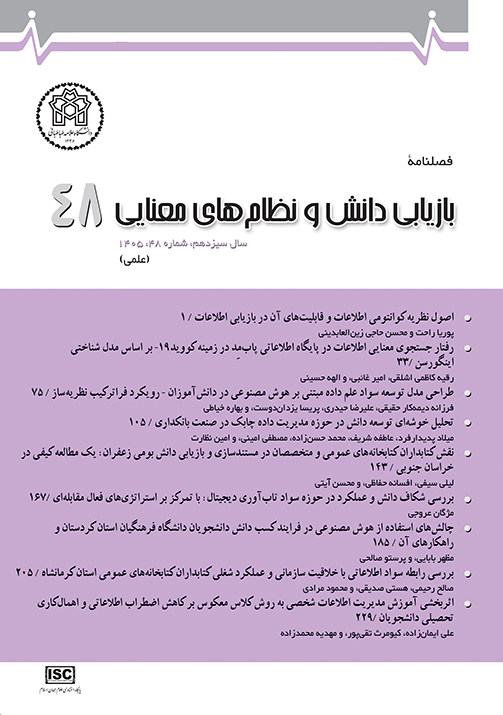
نقش کتابداران کتابخانه‌های عمومی و متخصصان در مستندسازی و بازیابی دانش بومی زعفران: یک مطالعه کیفی در خراسان جنوبی

نوع مقاله : مقاله پژوهشی

نویسندگان

1 گروه آموزشی علم اطلاعات و دانش‌شناسی، دانشکده علوم تربیتی و روان‌شناسی، دانشگاه بیرجند، بیرجند، ایران.

2 گروه آموزشی علوم تربیتی، دانشکده علوم تربیتی و روان‌شناسی، دانشگاه بیرجند، بیرجند، ایران.

چکیده
این پژوهش با هدف بررسی نقش کتابداران کتابخانه‌های عمومی و متخصصان جهاد کشاورزی در مستندسازی و بازیابی دانش بومی زعفران در خراسان جنوبی، ایران انجام شده است. پژوهش حاضر با رویکرد کیفی و روش مطالعه موردی انجام شد. داده‌ها از طریق مصاحبه‌های غیرساختاریافته با کتابداران کتابخانه‌های عمومی (20 نفر) و متخصصان جهاد کشاورزی (10 نفر) در خراسان جنوبی و با استفاده از نمونه‌گیری هدفمند گردآوری شد. مصاحبه‌ها بر شیوه‌های مستندسازی دانش بومی، سازوکارهای بازیابی، چالش‌های موجود و راهکارهای پیشنهادی تمرکز داشتند. داده‌ها با استفاده از تحلیل محتوای کیفی و از طریق کدگذاری باز، محوری و انتخابی تحلیل شدند. یافته‌ها نشان داد که دانش بومی زعفران عمدتاً از طریق روایت‌های شفاهی، مصاحبه با کشاورزان باتجربه، مستندسازی چندرسانه‌ای، منابع مکتوب و آرشیوهای محلی مستندسازی می‌شود. شیوه‌های بازیابی دانش شامل مخازن دیجیتال، نظام‌های اطلاعاتی، سازماندهی فراداده‌ها، کتابخانه‌های دیجیتال و میانجی‌گری اطلاعاتی بود. همچنین، پژوهش چالش‌های متعددی ازجمله ضعف زیرساخت‌های فناورانه، محدودیت همکاری‌های نهادی، نبود مشارکت کافی و نابودی تدریجی دانش بومی به دلیل سالخوردگی دارندگان دانش را شناسایی کرد. این پژوهش با تمرکز ویژه بر دانش بومی زعفران در خراسان جنوبی، به ادبیات محدود مدیریت دانش بومی کشاورزی در ایران کمک می‌کند. همچنین، نقش مشارکتی کتابداران و متخصصان جهاد کشاورزی را در حفاظت، سازماندهی و بازیابی دانش بومی کشاورزی برجسته می‌سازد. پژوهش حاضر نتیجه‌گیری می‌کند که حفاظت و بازیابی پایدار دانش بومی زعفران مستلزم همکاری یکپارچه میان کتابخانه‌ها، نهادهای کشاورزی، جوامع محلی و نظام‌های اطلاعاتی دیجیتال است.

کلیدواژه‌ها

موضوعات

عنوان مقاله English

The Role of Public Librarians and Agricultural Experts in the Documentation and Retrieval of Indigenous Saffron Knowledge: A Qualitative Study in South Khorasan

نویسندگان English

Leili Seifi 1
Afsaneh Hefazi 1
Mohsen Ayati 2
1 Department of Knowledge and Information Science, Faculty of Educational Sciences and Psychology, University of Birjand, Birjand, Iran.
2 Department of Educational Science, Faculty of Educational Sciences and Psychology, University of Birjand, Birjand, Iran.
چکیده English

Introduction
Indigenous agricultural knowledge is fundamental to rural livelihoods, cultural identity, and sustainable farming systems. Developed through generations of observation and adaptation, saffron-related knowledge in South Khorasan encompasses soil preparation, irrigation timing, corm selection, harvesting, drying, storage, and quality preservation (Mohammadi et al., 2023; Vafaee et al., 2024). However, much of this knowledge remains tacit, orally transmitted, and insufficiently documented, leaving it vulnerable to gradual loss. Public librarians can contribute by collecting, organizing, digitizing, preserving, and facilitating access to this knowledge, while agricultural experts can assist in its interpretation, validation, and transmission. Despite their complementary expertise, little research has examined their joint role in managing indigenous agricultural knowledge, particularly knowledge concerning saffron cultivation in Iran. Therefore, this qualitative study investigated the roles of public librarians and agricultural experts in documenting and retrieving indigenous saffron knowledge in South Khorasan, while identifying the challenges and strategies associated with its long-term preservation and accessibility.
Research Questions
1. What methods can public librarians and agricultural experts use to document and retrieve indigenous knowledge related to saffron production?
2. What challenges do public librarians and agricultural experts face in documenting and retrieving indigenous knowledge related to saffron production, and what strategies can be employed to address them?
Literature Review
Literature emphasizes stakeholder participation and collaborative knowledge ecosystems. Chigwada and Ngulube (2025) argue that indigenous knowledge initiatives require the involvement of local communities, librarians, cultural institutions, policymakers, and technical experts. Similarly, Dei (2024) found that indigenous knowledge is transmitted through storytelling, mentoring, festivals, rituals, and apprenticeships, although these practices often remain informal and undocumented. Indigenous knowledge management should therefore be understood as a social and cultural process grounded in trust, cultural legitimacy, and community participation, rather than as a technological activity. Although studies propose artificial intelligence-based systems, including Retrieval-Augmented Generation, for agricultural knowledge management (Han et al., 2026), such systems depend on structured, documented, and retrievable knowledge bases. Traditional agricultural practices, including saffron cultivation, are not yet systematically represented in digital infrastructures (Adefila et al., 2026). Existing research has primarily addressed preservation, dissemination, or digitization, with limited attention to agricultural knowledge retrieval. In Iran, no study has examined the combined roles of public librarians and agricultural experts in documenting, retrieving, and facilitating access to indigenous saffron knowledge in South Khorasan.
Methodology
This qualitative study employed a case study design to examine how indigenous saffron knowledge was documented and retrieved by public librarians and agricultural experts in South Khorasan. Using purposive judgmental sampling, 30 participants were recruited: 20 public librarians and 10 agricultural experts from Birjand, Qaen, Darmian, Sarbisheh, and Ferdows. Data were collected through semi-structured interviews lasting 40–70 minutes. Data saturation was reached after interviews with 17 librarians and eight agricultural experts; additional interviews were conducted to confirm saturation. The interview protocol was developed from the literature, and two pilot interviews were undertaken to refine the process. With informed consent, interviews were audio-recorded, transcribed, and analyzed using MAXQDA version 21. Coding proceeded through open, axial, and selective stages, involving the identification, comparison, consolidation, and categorization of codes into themes aligned with the questions. Credibility was supported through participant checking of interview interpretations. A second researcher coded the data, and intercoder reliability was assessed using Cohen's kappa, producing a coefficient of 0.98.
Results
The findings revealed that documenting and retrieving indigenous saffron knowledge required coordinated interaction among libraries, agricultural institutions, technologies, and local communities. Participants identified multiple documentation methods. Oral documentation was considered essential for capturing farmers' experiences and tacit knowledge. Multimedia approaches, such as audio, video, and photographic records, were viewed as suitable for preserving cultivation practices and locally embedded techniques. Participatory documentation involving farmers, librarians, and agricultural experts was also emphasized as a means of improving accuracy, contextual relevance, and community trust. For retrieval and access, participants recommended structured digital repositories, searchable databases, standardized indexing and metadata, mobile applications, and library-based information services. However, implementation was constrained by human, technological, managerial, cultural, and organizational challenges. The principal barriers included inadequate digital infrastructure, limited inter-organizational collaboration, difficulties accessing indigenous knowledge holders, insufficient managerial and financial support, limited technological competencies, and concerns regarding trust and ownership. Suggested strategies included strengthening collaboration among librarians, agricultural experts, farmers, and local institutions; expanding digital infrastructure; providing targeted education and professional training; developing supportive policies; and establishing ethical protocols for consent, ownership, and access. Collectively, these measures were considered necessary for ensuring the sustainable preservation, retrieval, dissemination, and intergenerational transmission of indigenous saffron knowledge.
Discussion
The findings demonstrated that the management of indigenous saffron knowledge required an integrated approach combining oral, participatory, multimedia, and digital practices. The importance of interviews, storytelling, and recording farmers' experiences confirmed that saffron knowledge remained tacit and intergenerational, consistent with Dei (2024) and Chisita (2011). Multimedia documentation can preserve the practical and contextual details of cultivation more effectively than written records alone, supporting earlier findings by Adeyemo and Adebayo (2018) and Chigwada and Ngulube (2024). However, documentation without organization and retrieval mechanisms cannot ensure meaningful access. Digital repositories, metadata, indexing, and searchable databases are therefore essential, as emphasized by Balogun (2023) and Goswami (2023). Their implementation in South Khorasan remains constrained by inadequate infrastructure, limited digital competencies, weak institutional coordination, and insufficient managerial support. Participants' concerns about trust, ownership, and reluctance to share knowledge further indicate that indigenous knowledge management is not merely a technical process but a culturally sensitive social practice. Consequently, preservation requires community consent, recognition of knowledge holders, capacity building, and collaboration among libraries, agricultural agencies, cultural institutions, and farmers. Librarians and agricultural experts should function jointly as documenters, validators, information intermediaries, and facilitators of intergenerational knowledge transmission.
Conclusion
This study concluded that managing indigenous saffron knowledge in South Khorasan required a comprehensive, participatory, and multidimensional approach. Much of this agricultural and cultural knowledge remained tacit, experiential, and orally transmitted among farmers and local experts, making it vulnerable to gradual disappearance. Public librarians and agricultural experts can identify, record, organize, preserve, and facilitate access to this knowledge through oral, written, multimedia, participatory, and digital documentation methods. Nevertheless, preservation is hindered by inadequate infrastructure, limited institutional cooperation, insufficient financial and managerial support, difficulties accessing knowledge holders, low appreciation of indigenous knowledge, and concerns about trust and ownership. Establishing an indigenous knowledge management system is essential. Such a system should combine documentation, organization, retrieval, access, dissemination, and intergenerational transmission while respecting cultural and ethical considerations. Institutional partnerships, community participation, digital infrastructure, information-literacy training, supportive policies, and trust can enable libraries and agricultural organizations to safeguard indigenous saffron knowledge for future generations.

کلیدواژه‌ها English

Indigenous Knowledge
Saffron Knowledge
Knowledge Documentation
Knowledge Retrieval
South Khorasan
ایمان‌زاده، علی، و پلنگی، کبری. (۱۳۹۵). بررسی رابطه بین اشتراک دانش و تعهد سازمانی در کتابداران دانشگاه‌های دولتی شهر تبریز. فصلنامه بازیابی دانش و نظام‌های معنایی، ۳(۸)، ۴۱–۶۰. https://doi.org/10.22054/jks.2017.18555.1119
حیاتی، ماندانا. (۱۳۹۴). مستندسازی دانش تجربی متخصصین شرکت‌های آب منطقه‌ای: رویکردی عملیاتی به فرایند مدیریت دانش طرح‌های توسعه منابع آب فارس ]پایان‌نامه کارشناسی ارشد، دانشگاه شیراز[.
حیاتی، ماندانا، جوکار، عبدالرسول، و ابراهیمی، سعیده. (۱۳۹۸). مستندسازی دانش تجربی آب: رویکردی عملیاتی به فرایند مدیریت دانش طرح‌های توسعه منابع آب. پژوهشنامه کتابداری و اطلاع‌رسانی، ۹(۱)، ۲۴۲–۲۶۱.
خزیمه‌نژاد، حسین، فرهنگ‌فر، همایون، بهدانی، محمدعلی، و حسن‌پور، مجتبی. (۱۳۹۴). بررسی دانش بومی زعفران‌کاران پیرامون مسائل مرتبط با آبیاری (مطالعه موردی: خراسان جنوبی). نشریه زراعت و فناوری زعفران، ۱(۴)، ۴۱–۵۰.
سیفی، لیلی. (۱۴۰۴). نقش کتابخانه‌های عمومی در حفاظت از دانش بومی: مطالعه فراترکیب. تحقیقات اطلاع‌رسانی و کتابخانه‌های عمومی، ۳۱(۱)، ۳۵–۵۲.
سیفی، لیلی، قاسمی‌پور، مریم، و آیتی، محسن. (۱۴۰۴). شناسایی نقش کتابخانه‌ها در مدیریت دانش بومی: مطالعه فراترکیب. مطالعات کتابداری و سازماندهی اطلاعات، ۳۶(۲)، ۷–۳۰.
سیفی، لیلی، و نوکندی، زینب. (۱۴۰۵). کتابخانه‌های روستایی به‌مثابه میانجی دانش بومی آب: مطالعه موردی خراسان جنوبی. مطالعات کتابداری و سازماندهی اطلاعات. https://doi.org/10.30484/nastinfo.2026.3960.2372
قاسم‌زاده، داود، و علیزاده اقدم، محمدباقر. (۱۴۰۳). مطالعه جامعه‌شناختی نقش جمع‌گرایی فرهنگی در اشتراک دانش (موردمطالعه: دانشجویان تحصیلات تکمیلی دانشگاه تبریز). فصلنامه بازیابی دانش و نظام‌های معنایی، ۱۱(۴۱)، ۶۳–۸۴. https://doi.org/10.22054/jks.2023.73206.1569
مسعودی‌فر، امید. (۱۳۹۵). زعفران در آینه دانش بومی میراث مکتوب کهن ایران. دوفصلنامه دانش‌های بومی ایران، ۶(۳)، ۲۱۱–۲۳۵.
هاشم‌زاده، محمدجواد، ناروئی، نسیمه، و سیفی، لیلی. (۱۴۰۵). از سنت شفاهی تا نظام‌های دیجیتال: الگوی مطلوب اشاعه و انتقال دانش بومی در صنایع‌دستی بلوچستان. مطالعات کتابداری و سازماندهی اطلاعات. https://doi.org/10.30484/nastinfo.2026.3946.2367
 
References
Abioye, A. A., Zaid, Y. A., & Egberongbe, H. S. (2014). Documenting and disseminating agricultural indigenous knowledge for sustainable food security: The efforts of agricultural research libraries in Nigeria. Libri: International Journal of Libraries & Information Services, 64(1), 75–84. https://doi.org/10.1515/libri-2014-0007
Adefila, A. O., Ajayi, O. O., Toromade, A. S., & Sam-Bulya, N. J. (2024). Integrating traditional knowledge with modern agricultural practices: A sociocultural framework for sustainable development. World Journal of Biology Pharmacy and Health Sciences, 20(2), 125–135. https://doi.org/10.54660/.JAMR.2024.3.1.74-93
Adefila, E., Oladokun, B. D., & Adewojo, A. A. (2026). Beginning of a new era: Leveraging digital twin technology in the preservation of indigenous knowledge systems in the disruptive era. Library Hi Tech News, 43(2), 4–8. https://doi.org/10.1108/LHTN-05-2024-0088
Adeyemo, A. A., & Adebayo, J. O. (2018). Documentation and dissemination of indigenous knowledge by library personnel in selected research institutes in Nigeria. Library Philosophy and Practice (e-journal), Article 1628. https://digitalcommons.unl.edu/libphilprac/1628
Afful-Arthur, P., Kwafoa, P. N. Y., Ampah-Johnston, M., & Mensah, V. (2022). Managing and accessing indigenous knowledge for national development: The role of academic libraries in Ghana. Information Development, 38(4), 535–548. https://doi.org/10.1177/02666669211009916
Aksoy, Z., & Oz, O. (2020). Protection of traditional agricultural knowledge and rethinking agricultural research from farmers' perspective: A case from Turkey. Journal of Rural Studies, 80(1), 291–301. https://doi.org/10.1016/j.jrurstud.2020.09.017
Asamoah, C., & Ngulube, P. (2023). Exploring models for the management of indigenous knowledge in academic libraries of Ghana. Information Development, 39(4), 787–797. https://doi.org/10.1177/02666669211052928
Balogun, T. (2023). Data management of digitized indigenous knowledge system in repositories. Information Development, 39(3), 425–438. https://doi.org/10.1177/02666669231186777
Balogun, T., & Kalusopa, T. (2022). Web archiving of indigenous knowledge systems in South Africa. Information Development, 38(4), 658–671. https://doi.org/10.1177/02666669211005522
Caviedes, J., Ibarra, J. T., Calvet-Mir, L., Álvarez-Fernández, S., & Junqueira, A. B. (2024). Indigenous and local knowledge on social-ecological changes is positively associated with livelihood resilience in a Globally Important Agricultural Heritage System. Agricultural Systems, 216, Article 103885. https://doi.org/10.1016/j.agsy.2024.103885
Chigwada, J., & Ngulube, P. (2024). Librarians' role in the preservation and dissemination of indigenous knowledge. IFLA Journal, 50(2), 242–256. https://doi.org/10.1177/03400352231217270
Chigwada, J., & Ngulube, P. (2025). Stakeholders in the acquisition, preservation, and dissemination of indigenous knowledge projects. Information Development, 41(4), 1281–1298. https://doi.org/10.1177/02666669231192851
Chisita, C. T. (2011, August). Role of libraries in promoting the dissemination and documentation of indigenous agricultural information: Case study of Zimbabwe. In World Library and Information Congress: 77th IFLA General Conference and Assembly. http://conference.ifla.org/past-wlic/2011/78-chisita-en.pdf
Chowdhury, G., McLeod, J., Lihoma, P., Teferra, S., & Wato, R. (2023). Promoting access to indigenous information in Africa: Challenges and requirements. Information Development, 39(3), 611–623. https://doi.org/10.1177/02666669211048488
Dei, D. G. J. (2024). Strategies for capturing, managing, and sharing indigenous knowledge. Information Development. Advance online publication. https://doi.org/10.1177/02666669241248832
Ghasemzadeh, D., & Alizadehaghdam, M. (2024). A sociological study of cultural collectivism in knowledge sharing (Case of study: Graduate students of Tabriz University). Knowledge Retrieval and Semantic Systems, 11(41), 63–84. https://doi.org/10.22054/jks.2023.73206.1569 [In Persian]
Goswami, P. R. (2023). Relevance of indigenous knowledge and possibility of its preservation, use, and dissemination by facilitation centers and libraries: Examples from India. The Serials Librarian, 84(5-8), 132–147. https://doi.org/10.1080/0361526X.2024.2318145
Han, N., Liu, D., & Norton, T. (2026). Towards an AI-based knowledge assistant for goat farmers based on Retrieval-Augmented Generation. Computers and Electronics in Agriculture, 245, Article 111542. https://doi.org/10.1016/j.compag.2026.111542
Hangshing, J., & Laloo, B. (2021). Role of libraries in preservation and accessibility of indigenous knowledge: A study of university libraries in Northeast India. Library Philosophy and Practice (e-journal), Article 5254. https://digitalcommons.unl.edu/libphilprac/5254
Hashemzadeh, M. J., Naroee, N., & Seifi, L. (2026). From oral tradition to digital systems: An optimal model for the dissemination and transmission of indigenous knowledge in the handicrafts of Balochistan. Librarianship and Information Organization Studies. Advance online publication. https://doi.org/10.30484/nastinfo.2026.3946.2367 [In Persian]
Haumba, E. N., & Kaddu, S. (2017). Documenting and disseminating agricultural indigenous knowledge for sustainable food security in Uganda. University of Dar es Salaam Library Journal, 12(1), 66–86.
Hayati, M. (2015). Documentation of experiential knowledge of regional water company experts: An operational approach to the knowledge management process of Fars water resources development projects [Master's thesis, Shiraz University]. [In Persian]
Hayati, M., Jowkar, A., & Ebrahimi, S. (2019). Documentation of experiential water knowledge: An operational approach to the knowledge management process of water resources development projects. Library and Information Science Research Journal, 9(1), 242–261. [In Persian]
Imanzadeh, A., & Palangi, K. (2016). The relationship between knowledge sharing and organizational commitment in public Tabriz universities librarians. Knowledge Retrieval and Semantic Systems, 3(8), 41–60. https://doi.org/10.22054/jks.2017.18555.1119 [In Persian]
Khozimehnejad, H., Farhangfar, H., Behdani, M. A., & Hassanpour, M. (2015). Investigating the indigenous knowledge of saffron farmers regarding irrigation-related issues (Case study: South Khorasan). Journal of Saffron Agronomy and Technology, 1(4), 41–50. [In Persian]
Masoudifar, O. (2016). Saffron in the mirror of indigenous knowledge: The ancient written heritage of Iran. Iranian Journal of Indigenous Knowledge, 6(3), 211–235. [In Persian]
Masuku, M., & Pasipamire, N. (2014). Going against the grain: Questioning the role of archivists and librarians in the documentation and preservation of indigenous knowledge. ESARBICA Journal, 33, 1–12.
Mohammadi, T., Moazzeni, H., Pirani, A., Vaezi, J., Motahhari, K., Joharchi, M. R., & Bussmann, R. W. (2023). Ethnobotany of plants used by indigenous communities in Birjand, a dry region with rich local traditional knowledge in eastern Iran. Ethnobotany Research and Applications, 26, 1–40. https://doi.org/10.32859/era.26.21.1-40
Pandy, V., Mittal, R., & Sharma, P. (2017). Documentation and application of indigenous traditional knowledge (ITK) for sustainable agricultural development. Asian Journal of Agricultural Extension, Economics & Sociology, 15(3), 1–9. https://doi.org/10.9734/AJAEES/2017/31099
Sarkhel, J. K. (2016). Strategies of indigenous knowledge management in libraries. Qualitative and Quantitative Methods in Libraries, 5(2), 427–439.
Seifi, L. (2025). The role of public libraries in preserving indigenous knowledge: A metasynthesis. Research on Information Science and Public Libraries, 31(1), 35–52. [In Persian]
Seifi, L., Ghasmeipoor, M., & Ayati, M. (2025). Identifying the role of libraries in indigenous knowledge management: A meta-synthesis study. Librarianship and Information Organization Studies, 36(2), 7–30. https://doi.org/10.30484/nastinfo.2024.3624.2283 [In Persian]
Seifi, L., Ghasemipoor, M., & Syamili, C. (2025). Librarians as stewards of indigenous knowledge: A meta-synthesis of roles, challenges, and strategies. International Journal of Information Science and Management, 23(4), 189–207. https://doi.org/10.22034/ijism.2025.2054683.1753
Seifi, L., & Nokandi, Z. (2026). Rural public libraries as mediators of indigenous water knowledge: A case study of South Khorasan. Librarianship and Information Organization Studies. Advance online publication. https://doi.org/10.30484/nastinfo.2026.3960.2372 [In Persian]
Tisdell, E. J., Merriam, S. B., & Stuckey-Peyrot, H. L. (2025). Qualitative research: A guide to design and implementation (5th ed.). John Wiley & Sons.
Vafaee, M., Ziaee, S., Mohammadi, H., & Borazjani, M. A. (2024). Spatial analysis of climate change on saffron yield (Case study of Khorasan Razavi, North Khorasan and South Khorasan cities). Journal of Agricultural Economics Research, 16(2), 91–100. [In Persian]
Vaidya, S. B. (2024). The role of libraries in preserving indigenous knowledge and culture. International Journal of Advanced Research and Multidisciplinary Trends, 1(2), 151–161.
Yin, R. K. (2018). Case study research and applications: Design and methods (6th ed.). Sage Publications.