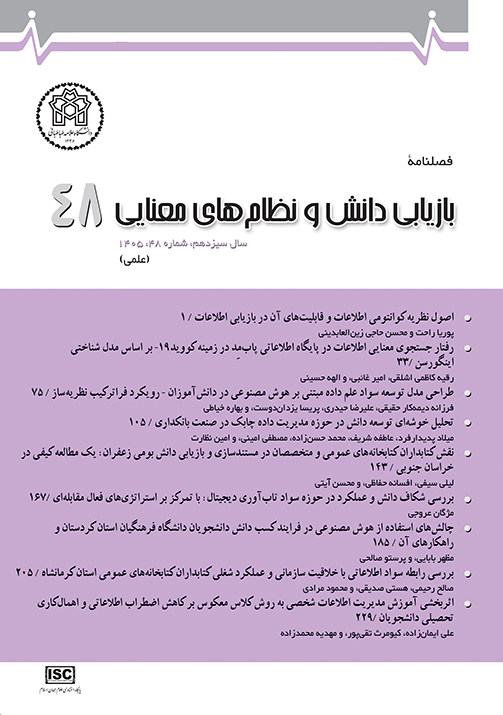
چالش‌های استفاده از هوش مصنوعی در فرایند کسب دانش دانشجویان دانشگاه فرهنگیان استان کردستان و راهکارهای آن

نوع مقاله : مقاله پژوهشی

نویسندگان

1 گروه آموزش ابتدایی، دانشکده‌ی علوم تربیتی، دانشگاه فرهنگیان، تهران، ایران.

2 گروه روان‌شناسی و آموزش کودکان استثنایی، دانشکده روان‌شناسی و علوم تربیتی، دانشگاه علامه طباطبائی، تهران، ایران.

چکیده
هدف پژوهش حاضر شناسایی چالش‌های استفاده از هوش مصنوعی در فرایند کسب دانش دانشجویان دانشگاه فرهنگیان استان کردستان و راهکارهای غلبه بر چالش‌های شناسایی شده بود. برای دستیابی هدف پژوهش از پارادایم انتقادی رویکرد کیفی و استراتژی پدیدارشناسی کلایزی بهره برده شد. میدان پژوهش شامل دانشجویان دانشگاه فرهنگیان استان کردستان در سال 1404 بود. گردآوری داده‌ها به‌وسیله‌ی مصاحبه‌ی نیمه‌ساختاریافته صورت گرفت. درمجموع با 32 دانشجو با انتخاب هدفمند و ملاک‌محور و بر مبنای دستیابی به اشباع در داده‌ها، مصاحبه به عمل آمد. تحلیل یافته‌ها به‌وسیله‌ی تحلیل استقرایی متن نوشتاری صورت گرفت. یافته‌های پژوهش در دو بخش، چالش‌های استفاده از هوش مصنوعی برای کسب و بازیابی دانش دانشجویان و راهکارهای غلبه بر چالش‌ها، ارائه شد. بخش چالش‌های در دو زمینه، ایجاد چالش برای جایگاه کسب دانش و بازیابی اطلاعات علمی و ایجاد چالش در کیفیت و کمیت کسب و بازیابی دانش ارائه شد. همچنین به راهکارهای غلبه بر این چالش‌ها در دو حیطه‌ی راهکارهایی در مقام فرد و راهکارهای مبتنی بر محیط سازمانی و آموزشی دانشگاه فرهنگیان پرداخته شد. تحلیل یافته‌ها نشان داد، هوش مصنوعی در کنار مزایای متعدد برای کسب و بازیابی دانش، می‌تواند ذهنیت دانشجویان دانشگاه فرهنگیان را نسبت به جایگاه آن، متزلزل کند و توانایی‌های علمی و مهارتی آنان را کاهش دهد؛ لذا نحوه‌ی استفاده از این ابزار، نیاز به مدیریت، فرهنگ‌سازی و زمینه‌سازی دارد. در این راستا با ایجاد تغییراتی همچون جایگزینی ارزشیابی نتیجه‌محور با گونه‌ی فرایندمحور آن در دانشگاه فرهنگیان و آموزش نحوه‌ی استفاده از هوش مصنوعی و مدیریت استفاده از آن به دانشجویان، می‌توان زمینه‌ی مناسب استفاده از هوش مصنوعی در کسب دانش در این دانشگاه را فراهم نمود.

کلیدواژه‌ها

موضوعات

عنوان مقاله English

Challenges of Using Artificial Intelligence in the Knowledge Acquisition Process of Students at Farhangian University of Kurdistan Province and Their Solutions

نویسندگان English

Mazhar Babaee 1
Parastoo Salehi 2
1 Department of Elementary Sciences, Faculty of Educational Sciences, Farhangian University, Tehran, Iran.
2 Department of Psychology and Education of Exceptional Children, Faculty of Psychology and Educational Sciences, Allameh Tabataba'i University, Tehran, Iran.
چکیده English

Introduction
Today, artificial intelligence is one of the new concepts in scientific and academic communities, and its application is evident in most scientific and applied fields. The benefits of artificial intelligence for acquiring, searching, and retrieving information and academic knowledge of students are undeniable, as evidence shows; however, its possible challenges in the process of acquiring knowledge cannot be ignored. The use of artificial intelligence by students to retrieve and acquire knowledge and information can bring both advantages and challenges, but what is important is that the advantages outweigh the challenges, and this will be possible when these challenges are identified and managed. Among the diverse students who use AI to search for information and knowledge, the importance of identifying and managing challenges for Farhangian University students is heightened. These students are responsible for educating the next generation, and the challenges of AI for their knowledge acquisition and retrieval may affect students who will be educated by them in the future. In this case, identifying the challenges of using AI to acquire knowledge among Farhangian University students is essential.
Research Questions
1. Considering the lived experiences of students at Farhangian University of Kurdistan Province, what challenges does the use of artificial intelligence pose for their knowledge acquisition and retrieval of scientific information?
2. Considering the lived experiences of students at Farhangian University of Kurdistan Province, what solutions are there to overcome the challenges of using artificial intelligence in students' knowledge acquisition and retrieval of scientific information?
Literature Review
Several studies have addressed the challenges posed by artificial intelligence for searching for information and acquiring knowledge in scientific and educational environments, as well as strategies for overcoming these challenges. These include Ghaeimi et al. (2025), who examined changes in subcultures and organizational climates of schools and universities and the formulation and adaptation of laws and regulations; Rajabiyan Dehzireh (2024), who addressed educational, interactive, technological, cultural, and economic challenges and proposed using artificial intelligence as an educational assistant, formulating policies and laws, teaching how to use artificial intelligence, and building culture; Motaghi Destenaei et al. (2024), who examined awareness of artificial intelligence and its role in education in order to reduce challenges; Mokhtari and Rezvani (2023), who addressed the inability of artificial intelligence to replace teachers; Mustopa et al. (2024), who pointed out the challenge of infrastructure and internet access in Indonesia, the challenge of the shortage of human resources and skilled instructors in the field of AI in India, and the challenge of balancing the use of advanced AI technologies, privacy protection, and capacity development to adapt to rapid advances in technology-based education in China; Jie and Kamrozzaman (2024), who pointed out the over-reliance on AI and the lack of awareness and understanding of students in using AI applications; and Saputra et al. (2023), who pointed out educational opportunities such as the provision of educational materials, assessment, management systems, and educational policy-making, and challenges such as educational ethics, limitations in preparing teachers for AI competencies, and slow changes in the structure of the curriculum and teaching.
Methodology
To achieve the research goal, the critical paradigm of the qualitative approach and the Colaizzi phenomenological strategy were used. The research field included students of Farhangian University of Kurdistan Province in 2025. Data collection was carried out through semi-structured interviews. A total of 32 students were interviewed through purposeful and criterion-based selection until data saturation was achieved. The findings were analyzed through inductive analysis of written text.
Results
The research findings were presented in two sections: challenges of artificial intelligence for students' knowledge acquisition and solutions to overcome the challenges. The section on challenges of artificial intelligence for students' knowledge acquisition was presented in two areas: challenges to the position of knowledge acquisition for students and challenges to the quality and quantity of knowledge acquisition by students. Also, solutions to overcome these challenges were discussed in two areas: individual solutions and solutions based on the scientific and educational environment of Farhangian University.
Conclusion
Regarding the challenge to the status of acquiring knowledge, issues such as reduced motivation to acquire knowledge, the habit of procrastinating in acquiring knowledge, reduced scientific responsibility, reduced creativity, and the loss of the value of the process of acquiring knowledge and interacting with scientific information were mentioned. Ultimately, these issues led to a decrease in the quality and quantity of students' knowledge, such as a decrease in their teaching knowledge and level of study and research, and also challenged their production of scientific texts. Such issues showed that the application of artificial intelligence by Farhangian University students did not simply lead to a decrease in their scientific level; rather, it undermined the status of acquiring knowledge and direct interaction with scientific information in their minds and made it appear less valuable, which ultimately led Farhangian University students to avoid acquiring knowledge and produced a generation of teachers who avoided science and were indifferent to the value and status of knowledge. Of course, these challenges are not limited to simply reducing the scientific level of future teachers; they also affect their students and will lead to a decrease in the level of knowledge and knowledge transfer in schools and a decrease in the status of teachers.
In order to overcome the challenges, students pointed out various solutions that fell into two areas: solutions based on students and solutions based on the educational and scientific environment of Farhangian University. According to the students, what needs to be considered regarding the application of artificial intelligence tools among Farhangian University students is preparing the ground and teaching them how to use these tools correctly, before the spread of excessive and unprincipled use at Farhangian University and the cultural lag of students in using them. This can ultimately prevent some of the deep challenges in acquiring knowledge and interacting with scientific information by students, as well as challenges based on the type of interaction they have with information in their future work. Therefore, the basic solution to overcome the challenges of artificial intelligence for acquiring knowledge and interacting with information among students at Farhangian University was to create an appropriate context and background at this university and to develop a principled procedure for using artificial intelligence in acquiring knowledge and interacting with information before learning it, which was possible without the use of coercion or arbitrary rules and by reforming the culture of using artificial intelligence.

کلیدواژه‌ها English

Knowledge Acquisition Process
Artificial Intelligence
Challenges
Solutions
Farhangian University Students
ایزدیان، ریحانه، گلینی‌مقدم، گلنسا، و ملکی، رضا. (۱۴۰۳). بررسی فرهنگ و روش‌های اشتراک‌گذاری دانش در میان کارکنان کتابخانه‌های عمومی شهرستان اهواز. فصلنامه بازیابی دانش و نظام‌های معنایی، ۱۱(۳۹)، ۱۴۹–۱۷۸. https://doi.org/10.22054/jks.2023.73520.1575
آذری، فاطمه، و عبدالهی، علی. (۱۴۰۴). ارزیابی بلوغ سازمانی هوش مصنوعی: مرور سیستماتیک ادبیات و استخراج چارچوب‌های بلوغ هوش مصنوعی. مدیریت استراتژیک هوشمند، ۴(۱)، ۱۴۵–۱۷۰. https://doi.org/bumara.3.2.11545654.545845.45
آراسته، حمیدرضا، و خباره، کبری. (۱۴۰۲). نقش هوش مصنوعی و تحول در آموزش عالی. نشاء علم، ۱۴(۱)، ۲–۸. https://www.sciencecultivation.ir/article_712679.html
حسن‌زاده، محمد. (۱۴۰۱). عامل‌های هوشمند و تسهیلات مدیریت دانش: چت‌جی‌پی‌تی و بعد از آن. علوم و فنون مدیریت اطلاعات، ۸(۴)، ۷–۲۲. https://doi.org/10.22091/stim.2023.2421
رجبیان ده زیره، مریم. (۱۴۰۳). شناسایی چالش‌ها و قابلیت‌های هوش مصنوعی در آموزش و یادگیری با ارائه راهکارها. فناوری آموزش، ۱۸(۴)، ۹۲۱–۹۵۰. https://doi.org/10.22061/tej.2024.10777.3058
صفری، ناهید، میرحسینی، زهره، و اباذری، زهرا. (۱۴۰۴). تحلیل رفتار اطلاع‌یابی پژوهشگران در حوزه هنر. فصلنامه بازیابی دانش و نظام‌های معنایی، ۱۲(۴۲)، ۲۲۱–۲۴۶. https://doi.org/10.22054/jks.2025.84074.1694
قائمی، فرشته، آقازاده، یوسف، و صالحی، کیوان. (۱۴۰۴). تحول آموزش با هوش مصنوعی: مرور نظام‌مند کاربردها، ظرفیت‌ها و دستاوردها. علوم و فنون مدیریت اطلاعات، ۱۱(۴)، ۷–۳۵. https://doi.org/10.22091/stim.2025.10570.2083
گنجی، بهرخ، و غریب شاه، محمد. (۱۴۰۳). مسیرهای پرچالش پیش روی آینده حقوق هوش مصنوعی. فصلنامه تمدن حقوقی، ۷(۲۲)، ۳۶۱–۳۷۶. https://doi.org/10.22034/lc.2024.483513.1547
متقی دستنائی، افشین، کرمی، علی، و پیری فتح‌آباد، میلاد. (۱۴۰۳). آسیب‌شناسی کاربردهای هوش مصنوعی در آموزش با استفاده از روش تحلیل سوآت. تعامل انسان و اطلاعات، ۱۱(۲)، ۱–۲۲. https://hii.khu.ac.ir/article_4423.html
محرابی، نازیلا، خراشادی‌زاده، سحر، و کریمیان، راحله. (۱۴۰۲). شناسایی مؤلفه‌های هوش مصنوعی در پیاده‌سازی مدیریت دانش. علوم و فنون مدیریت اطلاعات، ۹(۳)، ۳۵۱–۳۹۰. https://doi.org/10.22091/stim.2023.8924.1906
محمودی، حمیدرضا، محرابی، نازیلا، و دائی، عذرا. (۱۴۰۳). شناسایی مؤلفه‌های کلیدی ارزیابی عملکرد فناوری‌های دانش از دیدگاه خبرگان (یک پژوهش آمیخته). فصلنامه بازیابی دانش و نظام‌های معنایی، ۱۱(۴۰)، ۲۲۹–۲۶۷. https://doi.org/10.22054/jks.2023.70094.1536
مختاری، سید علی‌محمد، و رضوانی، ریحانه. (۱۴۰۱). کاربرد هوش مصنوعی در آموزش تاریخ. پژوهش در آموزش تاریخ، ۳(۴)، ۵۳–۶۵. https://dor.isc.ac/dor/20.1001.1.28211014.1401.3.4.5.9
میری بالاجورشری، سیده مهشید، و محمودی، امیررضا. (۱۴۰۳). واکاوی مسائل اخلاقی در زمینه هوش مصنوعی با نگاهی به اخلاق اسلامی. فصلنامه علمی‌ـ‌پژوهشی مطالعات اخلاق کاربردی، ۲۰(۱)، ۹۷–۱۲۳. https://doi.org/10.22081/jare.2024.68803.1901
میری، سید جواد، و روحانی، حسین. (۱۴۰۱). مقایسه آرای مارتین هایدگر و علی شریعتی در قبال تکنولوژی. مجله پژوهش‌های فلسفی، ۱۶(۳۹)، ۶۲۶–۶۴۲. https://doi.org/10.22034/jpiut.2021.48484.3018
ویسی، مرجان. (۱۴۰۲). چگونگی تحول جهان ما توسط هوش مصنوعی: فرصت‌ها، چالش‌ها و ملاحظات اخلاقی. فصلنامه پژوهش‌های نوین در شهر هوشمند، ۱(۴)، ۸۵–۹۵. https://dorl.net/dor/20.1001.1.29808936.1402.1.4.6.8
References
Akgun, S., & Greenhow, C. (2022). Artificial intelligence in education: Addressing ethical challenges in K-12 settings. AI and Ethics, 2, 431–440. https://doi.org/10.1007/s43681-021-00096-7
Arasteh, H. R., & Khabareh, K. (2023). The role of artificial intelligence and transformation in higher education. Science Cultivation, 14(1), 2–8. https://www.sciencecultivation.ir/article_712679.html  [In Persian]
Azari, F., & Abdollahi, A. (2025). Evaluation of organizational AI maturity: A systematic literature review and extraction of AI maturity frameworks. Journal of Intelligent Strategic Management, 4(1), 145–170. [In Persian]
Colaizzi, P. F. (1978). Psychological research as a phenomenologist views it. In R. S. Valle & M. King (Eds.), Existential-phenomenological alternatives for psychology (pp. 48–71). Oxford University Press.
Ganji, B., & Gharibshah, M. (2025). Challenging paths to the future of artificial intelligence law. Fares Law Research, 7(22), 361–376. https://doi.org/10.22034/lc.2024.483513.1547 [In Persian]
Ghaeimi, F., Aghazadeh, Y., & Salehi, K. (2025). Transforming education with artificial intelligence: A systematic review of applications, potentials, and outcomes. Sciences and Techniques of Information Management, 11(4), 7–35. https://doi.org/10.22091/stim.2025.10570.2083 [In Persian]
Hassanzadeh, M. (2022). Intelligent agents and facilities for knowledge management: ChatGPT and beyond. Sciences and Techniques of Information Management, 8(4), 7–22. https://doi.org/10.22091/stim.2023.2421 [In Persian]
Izadian, R., Galyani-Moghaddam, G., & Maleki, R. (2024). Knowledge sharing culture and methods among public libraries' staff in Ahvaz City. Knowledge Retrieval and Semantic Systems, 11(39), 149–178. https://doi.org/10.22054/jks.2023.73520.1575 [In Persian]
Jie, A. L. X., & Kamrozzaman, N. A. (2024). The challenges of higher education students face in using Artificial Intelligence (AI) against their learning experiences. Open Journal of Social Sciences, 12(10), 362–387. https://doi.org/10.4236/jss.2024.1210025
Kuleto, V., Ilić, M., Dumangiu, M., Ranković, M., Martins, O. M., Păun, D., & Mihoreanu, L. (2021). Exploring opportunities and challenges of artificial intelligence and machine learning in higher education institutions. Sustainability, 13(18), Article 10424. https://doi.org/10.3390/su131810424
Mahmoodi, H., Mehrabi, N., & Daei, A. (2024). Identifying the key components of evaluating the performance of knowledge technologies from the point of view of experts (A mixed research). Knowledge Retrieval and Semantic Systems, 11(40), 229–267. https://doi.org/10.22054/jks.2023.70094.1536 [In Persian]
Mehrabi, N., Khorashadizadeh, S., & Karimian, R. (2023). Identifying the components of artificial intelligence in the implementation of knowledge management. Sciences and Techniques of Information Management, 9(3), 351–390. https://doi.org/10.22091/stim.2023.8924.1906 [In Persian]
Miri, S. J., & Rouhani, H. (2022). Comparing Martin Heidegger's and Ali Shariati's views of technology. Journal of Philosophical Investigations, 16(39), 626–642. https://doi.org/10.22034/jpiut.2021.48484.3018 [In Persian]
Miri Balajorshari, S. M., & Mahmoudi, A. (2024). Analysis of ethical challenges in the field of artificial intelligence with an approach to Islamic ethics. Quarterly Scientific Journal of Applied Ethics Studies, 20(1), 97–123. https://doi.org/10.22081/jare.2024.68803.1901 [In Persian]
Mokhtari, S. A., & Rezvani, R. (2023). Application of artificial intelligence in history education. Research in History Education, 3(4), 53–65. [In Persian]
Motaghi Destenaei, A., Karami, A., & Piri Fath Abad, M. (2024). Pathology of artificial intelligence applications in education using the SWOT analysis method. Human Information Interaction, 11(2), 1–22. https://hii.khu.ac.ir/article_4423.html  [In Persian]
Mustopa, M., Nasikhin, N., Chamami, R., Nihayah, H., Habibullah, M. R., & Manshur, A. (2024). Challenges in artificial intelligence development in higher education in China, India, and Indonesia: International students' perspectives. International Journal of Learning, Teaching and Educational Research, 23(2), 354–373. https://doi.org/10.26803/ijlter.23.2.17
Rahayu, S. (2023). The impact of artificial intelligence on education: Opportunities and challenges. Educatio FKIP UNMA, 9(4), 2132–2140. https://doi.org/10.31949/educatio.v9i4.6110
Rajabiyan Dehzireh, M. (2024). Identifying the challenges and capabilities of artificial intelligence in teaching and learning by providing solutions. Technology of Education Journal, 18(4), 921–950. https://doi.org/10.22061/tej.2024.10777.3058 [In Persian]
Safari, N., Mirhosseini, Z., & Abazari, Z. (2025). Analyzing the information-seeking behavior of researchers in the field of art. Knowledge Retrieval and Semantic Systems, 12(42), 221–246. https://doi.org/10.22054/jks.2025.84074.1694 [In Persian]
Saputra, I., Astuti, M., Sayuti, M., & Kusumastuti, D. (2023). Integration of artificial intelligence in education: Opportunities, challenges, threats and obstacles. A literature review. The Indonesian Journal of Computer Science, 12(4), 1590–1600. https://doi.org/10.33022/ijcs.v12i4.3266
Veisi, M. (2023). How artificial intelligence is transforming our world: Opportunities, challenges, and ethical considerations. New Research in Smart Cities, 1(4), 85–95. https://dorl.net/dor/20.1001.1.29808936.1402.1.4.6.8  [In Persian]
Wang, Z., & Zhai, J. (2019). Ethical challenges faced by students in the educational environment of artificial intelligence. In International Conference on Advanced Education Research and Modern Teaching (AERMT 2019) (Vol. 350, pp. 1–3). Atlantis Press. https://doi.org/10.2991/aermt-19.2019.1